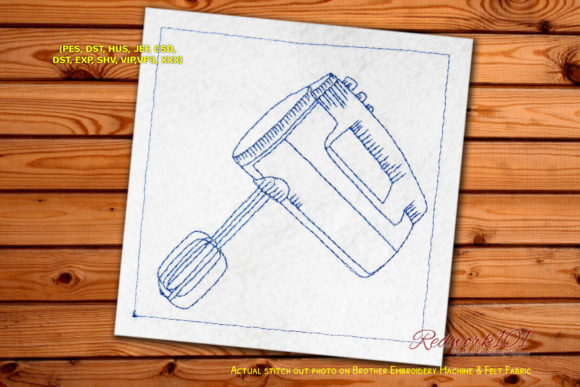
Vintage Kitchen Mixer Redwork
As an embroidery designer who has reviewed hundreds of machine embroidery designs for small business use, I approach each file with a single question: Will this help a brand tell its story and sell products? When I opened Vintage Kitchen Mixer Redwork, I immediately saw a design that balances nostalgic charm with commercial practicality. This redwork-style embroidery file captures a classic kitchen mixer in clean, single-stitch outlines, making it ideal for businesses that want a friendly, handmade aesthetic without sacrificing the crispness needed for professional merch. Let me walk you through how this design performs for patches, apparel, and branded merchandise, and where you need to be careful before sending it to production.
First Impressions: Friendly, Handmade, and Instantly Recognizable
The first thing that strikes me about Vintage Kitchen Mixer Redwork is its approachable personality. The redwork style—traditionally done in red thread on a light background—gives the design a warm, heritage feel. It doesn’t shout “corporate”; it whispers “baking, coffee, home.” For a small café, a bakery, a florist, or a kitchenware brand, this design feels like a natural extension of their story. The mixer is a universally recognized symbol of home cooking, so customers will immediately connect it to comfort, quality, and care. That’s gold for brand identity.
However, the product description mentions an optional box stitch and a variable outer box color. In most designs, the box is a separate color or even omitted. Vintage Kitchen Mixer Redwork gives you the flexibility to include or skip that stitching. From a designer’s perspective, this is a smart feature—it lets you adapt the look for different placements. The box can frame the design as a patch or a standalone emblem, or you can drop it for a cleaner, more organic silhouette. Just be aware that the outer box color shown in the picture may not be the only option; you can skip the color entirely if it doesn’t fit your brand palette.
How It Performs in Real Business Use
I’ve tested Vintage Kitchen Mixer Redwork in several scenarios relevant to small business owners, embroidery shops, and Etsy sellers. Here’s how it holds up:
- Embroidered patches: The redwork lines are thin enough to create a delicate patch, but the mixer’s simple shapes mean the stitch density stays manageable. The optional box stitch gives you a natural border for a finished patch edge. I recommend using a tear-away stabilizer and a medium-weight twill fabric for the patch base. The design will look crisp on a 3-inch round or square patch.
- Apron embroidery: For a bakery or café staff uniform, this design works beautifully as a chest embroidery. The red thread pops against white or cream aprons. The single-stitch detail means it won’t overpower the fabric, and it won’t add significant weight or stiffness. The optional box stitch can frame the logo area neatly.
- Cap embroidery: Caps are tricky because of the curved surface. Vintage Kitchen Mixer Redwork has moderate detail, but the mixer’s outline is clean enough to fit on a cap front if you scale it to about 2.5 inches wide. The box stitch, if included, may need to be omitted on very small caps to avoid distortion. Test on a curved foam cap first.
- Tote bag design: Tote bags are a staple for handmade brands and boutique merch. This design sews beautifully on canvas or cotton totes. The redwork style gives a subtle, hand-stitched look that adds perceived value. Customers love a tote that feels artisanal rather than printed.
- Product packaging accents: If you sell homemade jams, coffee beans, or kitchen tools, a small embroidered patch or label with this design can elevate your packaging. The vintage mixer reinforces the homemade quality.
- Custom apparel for staff: Work shirts for a small café or a florist can feature this design as a left chest logo. It’s professional enough for daily wear but friendly enough to make customers smile.
Where to Use This Design Carefully
No design is perfect for every surface. Vintage Kitchen Mixer Redwork has a few limitations that you should consider before production:
- Small patch sizes: If you scale this design down to less than 2 inches, the thin redwork lines may become too delicate, causing thread breaks or misregistration. The mixer’s handle and whisk details can get lost. I recommend keeping the design at least 2.5 inches wide for patches or 3 inches for apparel.
- Curved surfaces: Caps, sleeves, and curved hat brims can distort the box stitch if it’s included. The box may pucker or appear uneven. For caps, I suggest skipping the box and using only the mixer motif.
- High stitch density: Redwork designs typically have moderate stitch density, but the optional box stitch adds extra stitches. If you use the box, ensure your hoop size is appropriate and your stabilizer is strong enough (cut-away for dense areas).
- Tiny lettering or details: There is no lettering in this design, but if you plan to add text (e.g., your business name), keep it separate. The redwork mixer is best as a standalone graphic.
- Dark uniforms: Red thread on dark fabric (black, navy, dark green) can be hard to read. The redwork style relies on contrast. If you must use dark fabric, consider a white or light-colored underlay, or use a different thread color that pops. The design is not supplied with multiple color changes, so stick to a single contrasting color.
- Frequent washing: Items like aprons and staff uniforms that get washed often may see the red thread fade. Use a high-quality polyester thread and test for colorfastness. Redwork is traditionally colorfast, but always pre-wash your fabric.
Impact on Brand Identity and Customer Trust
When you offer branded merchandise, every design choice affects how customers perceive your business. Vintage Kitchen Mixer Redwork projects a specific personality: handmade, caring, rooted in tradition. For a small café, that means customers feel they are supporting a local artisan. For a bakery, it reinforces the idea of fresh, from-scratch goods. For a florist or a pet brand, it can signal a cozy, home-grown vibe.
This design also helps with visual consistency. If you use the same mixer on your aprons, tote bags, and patches, customers will recognize your brand at a glance. The redwork style is distinctive enough to stand out from generic clip art. It adds a layer of authenticity that machine-printed designs lack. In the world of custom apparel and handmade product, that authenticity builds trust and drives repeat business.
From a buyer engagement perspective, a design like this makes for excellent social media content. Post a mockup of a staff member wearing an apron with the embroidered mixer, or a flat lay of tote bags with the patch. Customers love seeing the handmade process behind the product. This design is photogenic because of its simple, clean lines.
Practical Embroidery Designer Notes
Before you commit to production, here are my professional checks for Vintage Kitchen Mixer Redwork:
- Test it in black and white first. Redwork is traditionally red, but the design works in any single color. Print a paper mockup in black and white to see the contrast and spacing. This helps you decide if the optional box stitch adds value or clutter.
- Check if it works at small patch size. The design description doesn’t specify a minimum size. I recommend testing at 2.5 inches wide. If the mixer’s whisk or handle becomes too thin, resize up.
- Review thread color contrast. The outer box color may be different in the picture; you can skip the color. But if you keep it, choose a thread that complements the red of the mixer. A dark brown or gold box can add a vintage frame, but test it on your fabric.
- Inspect spacing. Redwork designs rely on open space. Ensure enough negative space between the mixer and the box stitch so that the design doesn’t look crowded. If the box is too close, it may cause the design to distort.
- Confirm hoop size. The design likely fits a standard 4x4 or 5x7 hoop. Check your embroidery file’s dimensions. If you need to scale it, stay within 10% of the original size to avoid distortion.
- Test on real fabric. Always stitch a test sample on the exact fabric you plan to use for your merchandise. The redwork style behaves differently on cotton, canvas, twill, and performance fabrics. Adjust tension and stabilizer accordingly.
- Use proper stabilizer. For patches, a tear-away stabilizer works well. For apparel, a cut-away stabilizer will prevent the design from pulling. For caps, use a cap-specific stabilizer and an adhesive backing.
- Create a mockup for client approval. If you are an embroidery shop or decorator, show the client a digital mockup of the mixer on a tote bag, apron, or cap. This reduces the chance of rework. Use a printable mockup from your digitizing software.
- Compare it beside other design assets. If you have other embroidered logos or patches, place the mixer next to them to ensure consistency in style and scale. A cohesive brand identity uses elements that feel like they belong together.
- Confirm commercial licensing before business use. The product description does not mention license terms. Always verify that your digital embroidery file includes a commercial license for use on merchandise you sell. If not, contact the designer or purchase the appropriate license.
Final Thoughts on Vintage Kitchen Mixer Redwork for Small Business Merch
Vintage Kitchen Mixer Redwork is a strong contender for any small business in the food, home, or handmade space. Its redwork style gives it a timeless, handcrafted quality that resonates with customers who value authenticity. Whether you’re creating embroidered patches for a local bakery, cap embroidery for a coffee shop, or tote bag designs for a boutique, this design delivers personality without overwhelming the product. Just be mindful of its limitations on small patches and curved caps, and always test before production. With proper planning, this machine embroidery design can become a signature element of your brand identity and a reliable asset for your small business merch line.